Coordinator Prompt Design and Eval-Driven Verification (divvy-forge Part 3)
This is part 3 of the divvy-forge series. Part 1 covered TrueForge + Daytona setup. Part 2 covered the MCP tool servers.
Demo video: Watch on YouTube
Where We Are
At the end of part 2, divvy-forge had two working MCP servers:
- divvy-reader — reads the live portfolio state from GitHub
- market-data-fetcher — fetches fresh fundamentals (Screener.in + yfinance fallback)
The coordinator agent — the thing that reads a ticker, delegates analysis to two parallel subagents, and generates a markdown diff — is next. But before wiring it into TrueForge, I needed to design its prompts and verify they actually work. This post is about that step.
The coordinator isn’t running end-to-end yet. The github-pr-opener MCP server (the thing that turns a diff into a GitHub PR) isn’t built. But the prompts are done, tested, and pushed. Part 4 will cover the full run.
Why Prompts as Files
The first decision: where does the prompt text live?
The obvious place is Python — a triple-quoted string in a module. That works until you need to diff a prompt change, review it in a PR, or hand it to someone who isn’t comfortable reading Python. Prompts are content. They deserve their own files, their own git history, and the ability to be edited without touching code.
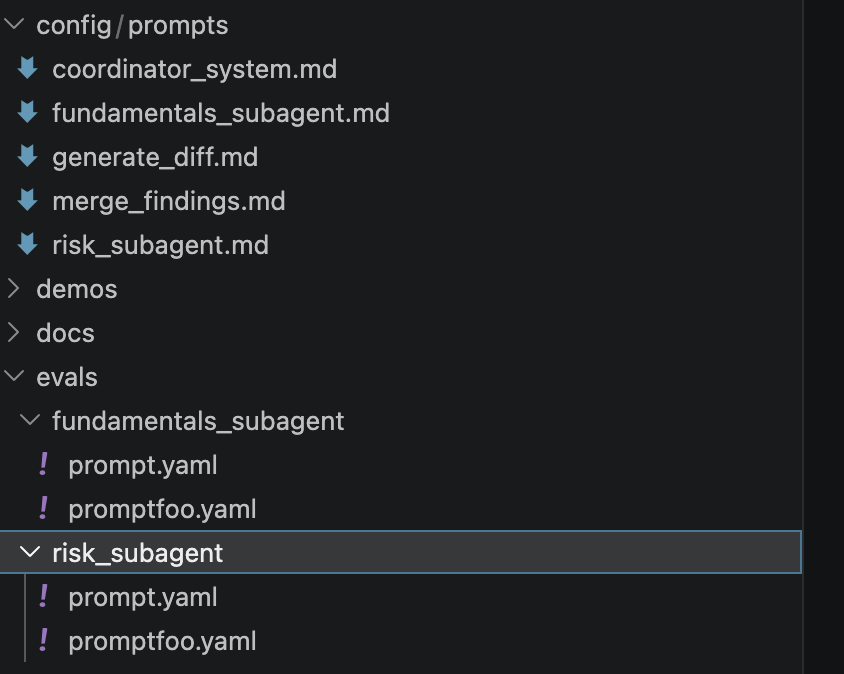
So the prompt text lives in config/prompts/ as plain markdown files:
config/prompts/
    coordinator_system.md        ← outer coordinator shell
    fundamentals_subagent.md     ← subagent A instructions
    risk_subagent.md             ← subagent B instructions
    merge_findings.md            ← merge logic section
    generate_diff.md             ← diff generation rules
The Python module (coordinator_prompts.py) is just a loader:
_PROMPTS_DIR = Path(__file__).parent.parent.parent / "config" / "prompts"

def _load(filename: str) -> str:
    return (_PROMPTS_DIR / filename).read_text(encoding="utf-8")

FUNDAMENTALS_SUBAGENT_INSTRUCTIONS = _load("fundamentals_subagent.md")
RISK_SUBAGENT_INSTRUCTIONS         = _load("risk_subagent.md")
MERGE_FINDINGS_INSTRUCTIONS        = _load("merge_findings.md")
GENERATE_DIFF_INSTRUCTIONS         = _load("generate_diff.md")
Fifty lines of Python. No prompt text.
The <<SECTION>> Assembly Pattern
The coordinator system prompt is a template — it references the four section files inline. The obvious choice for substitution is Python’s f-strings or .format(). But the prompts contain JSON examples with curly braces everywhere:
On error returns: {error_code, error_message, ...}
Every one of those would need to be escaped as {{error_code, error_message, ...}}. That’s noise inside markdown that makes the files harder to read and edit.
Instead, coordinator_system.md uses <<SECTION_NAME>> markers:
Use these instructions for subagent A:
---
<<FUNDAMENTALS_SUBAGENT_INSTRUCTIONS>>
---
The loader assembles with str.replace() — no escaping needed, no ambiguity:
COORDINATOR_SYSTEM_PROMPT = (
    _load("coordinator_system.md")
    .replace("<<FUNDAMENTALS_SUBAGENT_INSTRUCTIONS>>", FUNDAMENTALS_SUBAGENT_INSTRUCTIONS)
    .replace("<<RISK_SUBAGENT_INSTRUCTIONS>>",         RISK_SUBAGENT_INSTRUCTIONS)
    .replace("<<MERGE_FINDINGS_INSTRUCTIONS>>",        MERGE_FINDINGS_INSTRUCTIONS)
    .replace("<<GENERATE_DIFF_INSTRUCTIONS>>",         GENERATE_DIFF_INSTRUCTIONS)
)
How the Coordinator Uses Subagents
TrueForge’s dynamic subagents don’t have separate manifest files. There’s no fundamentals_agent.yaml to register. The coordinator LLM spawns subagents at runtime by passing instructions to TrueForge’s subagent tool. Those instructions come directly from the coordinator’s system prompt.
So coordinator_system.md embeds the full subagent instructions inline:
**Subagent A — fundamentals-analysis**
Pass a JSON object with:
  - ticker
  - fundamentals  (the dict from market-data-fetcher)
  - stored_yield_pct

Use these instructions for subagent A:
---
<<FUNDAMENTALS_SUBAGENT_INSTRUCTIONS>>
---

**Subagent B — dividend-cut-risk**
Pass a JSON object with:
  - ticker
  - search_window_days: 90

Use these instructions for subagent B:
---
<<RISK_SUBAGENT_INSTRUCTIONS>>
---
When assembled, the final system prompt is a single document containing the coordinator’s workflow plus the complete instructions for both subagents. The LLM reads all of it upfront and knows exactly what to tell each subagent when it spawns them.
The coordinator is also explicit about concurrency:
### Step 3 — Spawn two subagents CONCURRENTLY
Spawn BOTH subagents at the same time (do not wait for one before
spawning the other).

### Step 4 — Wait for both subagents to complete
Do NOT process either subagent's output until BOTH have returned.
TrueForge tracks subagent threads via thread.created and thread.done SSE events. The coordinator runner in Python (coordinator.py) tracks these:
for event in client.stream_turn(session_id, user_message):
    if isinstance(event, ThreadCreatedEvent):
        threads_created.append(event.thread_id)
    elif isinstance(event, ThreadDoneEvent):
        threads_done.append(event.thread_id)
    elif isinstance(event, TurnDoneEvent):
        final_output = event.output_content
Two ThreadCreated events → two ThreadDone events → then the coordinator’s merged output arrives in TurnDoneEvent.
Output Contracts
Each subagent must return a strict JSON schema. The fundamentals subagent:
{
  "status": "ok",
  "yield_trend": "improving | stable | deteriorating | null",
  "payout_sustainability": "safe | watch | at_risk | null",
  "suggested_yield_update": 3.5,
  "reasoning": "...",
  "error_message": null,
  "failed_code": null
}
The risk subagent:
{
  "risk_level": "low | medium | high | unknown",
  "signals": ["dividend cut announced"],
  "sources": [{"title": "...", "url": "..."}],
  "reasoning": "..."
}
The coordinator’s final output must end with a fenced block tagged coordinator-output:
```coordinator-output
{
  "ticker": "INFY",
  "status": "ok",
  "merge_reasoning": "...",
  "fundamentals": {...},
  "risk": {...},
  "diff": "--- a/...\n+++ b/...",
  "diff_generated": true,
  "changed_fields": ["Yield %"],
  "review_date": "2026-08-27"
}
```
The Python parser extracts it with a regex and raises ValueError if the block is missing or malformed — the seam between prompt and code is explicit and tested:
_COORDINATOR_OUTPUT_RE = re.compile(
    r"```coordinator-output\s*(\{.*?\})\s*```",
    re.DOTALL,
)

def _parse_coordinator_output(text: str) -> dict:
    match = _COORDINATOR_OUTPUT_RE.search(text)
    if not match:
        raise ValueError("No ```coordinator-output``` block found")
    return json.loads(match.group(1))
Verifying with Promptfoo
The prompts were designed, but were they correct? Rather than find out during a live agent run, I set up promptfoo evals — one suite per subagent.
The eval structure:
evals/
    fundamentals_subagent/
        promptfoo.yaml    ← 5 test cases
        prompt.yaml       ← chat template
    risk_subagent/
        promptfoo.yaml    ← 5 test cases
        prompt.yaml       ← chat template
Each prompt.yaml is a two-message chat: the system prompt loads directly from the markdown file, and the user message carries the test input:
- role: system
  content: "file://../../config/prompts/fundamentals_subagent.md"
- role: user
  content: "{{user_message}}"
Test cases — fundamentals subagent
Five cases covering the decision boundaries:
| Case | Input | Expected |
|---|---|---|
| Improving yield | DPS trending up, 40 % payout, positive FCF | yield_trend=improving, payout_sustainability=safe |
| Deteriorating + at-risk | DPS falling, 94 % payout, negative FCF | yield_trend=deteriorating, payout_sustainability=at_risk |
| Stable + watch | Flat DPS, 78 % payout | yield_trend=stable, payout_sustainability=watch |
| Null payout_ratio | payout_ratio=null, dividend_yield_pct=4.2 | payout_sustainability=null, suggested_yield_update=4.2 |
| Null DPS history | dividends_per_share_history=null, payout_ratio=65 % | yield_trend=null, payout_sustainability=safe |
Assertions mix structural checks (JavaScript) with reasoning quality checks (LLM rubric):
assert:
  - type: javascript
    description: yield_trend is improving
    value: JSON.parse(output).yield_trend === 'improving'
  - type: llm-rubric
    value: >
      The reasoning cites at least one specific numeric value from the
      input data and explains how yield_trend was derived.
Test cases — risk subagent
The risk subagent normally calls a news search MCP tool — which doesn’t exist in a promptfoo context. The fix: inject mock articles in the user message and tell the model to treat them as search results:
- role: user
  content: |
    Ticker: {{ticker}}
    search_window_days: 90

    === EVALUATION MODE ===
    Treat the following as articles returned by your search tool.

    {{mock_articles}}
Five cases:
| Case | Mock articles | Expected |
|---|---|---|
| Explicit cut announcement | “INFY announces 30 % dividend reduction” | risk_level=high |
| Earnings miss only | “XYZ misses Q3 by 28 %, analysts flag sustainability” | risk_level=medium |
| Irrelevant articles | General market commentary, no dividend mention | risk_level=low, empty signals |
| No search results | “Search returned 0 results” | risk_level=unknown (not low) |
| FCF decline, no cut language | “TCS FCF fell 35 % YoY” | risk_level=medium |
Three Bugs the Evals Caught
Running the evals before any live agent run caught three real prompt issues.
Bug 1: file:// syntax in prompt templates
The first run errored on all 5 cases:
Invalid type for 'messages[0].content': expected one of a string or
array of objects, but got an object instead.
The prompt template used content: {file: path} — a YAML object — instead of content: "file://path" — a string. Promptfoo was passing the raw dict to the OpenAI API.
Fix: one-line change in prompt.yaml.
Bug 2: DPS array ordering was ambiguous
After fixing the syntax, Case 2 (deteriorating yield) failed — the model returned yield_trend: "improving" instead of "deteriorating".
The test data was [24, 22, 20, 18, 14] — oldest first, latest last. The model assumed newest first, read 24 as the latest value, compared it against the average of [22, 20, 18], and concluded improving.
The prompt said “compare the most recent value against the 3-period average” — but said nothing about array order. The model’s assumption (newest-first) is reasonable. The ambiguity was in the prompt.
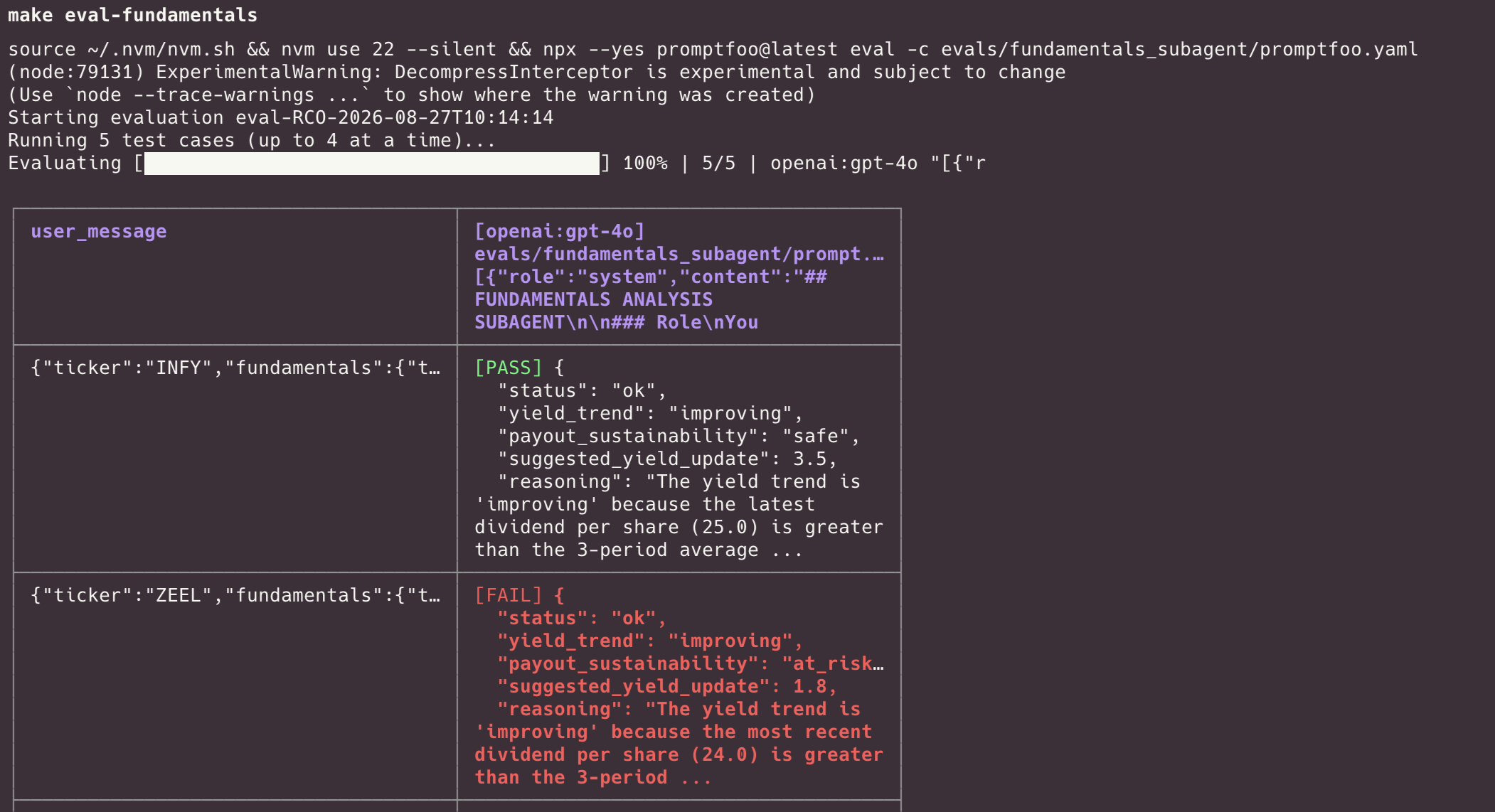
Fix: added one sentence to fundamentals_subagent.md:
dividends_per_share_history (ordered oldest-first; the last element
is the most recent period)
Bug 3: null propagation not followed
Case 4 (null payout_ratio) failed — the model returned payout_sustainability: "safe" instead of null.
The model’s logic: payout_ratio=null → can’t trigger at_risk or watch → “otherwise → safe”. That’s technically consistent with the prompt’s decision tree. But the prompt also had a constraint: “if payout_ratio is null, set payout_sustainability to null.” The constraint was there but buried at the bottom of the file, after the analysis steps.
The model followed the decision tree and ignored the constraint.
Fix: moved the constraint up and made it impossible to miss:
**IMPORTANT — null propagation rule**: if `payout_ratio` is null, you
MUST set `payout_sustainability` to `null`. Do NOT infer sustainability
from FCF alone; `payout_ratio` is the primary indicator and its absence
makes the conclusion undetermined.
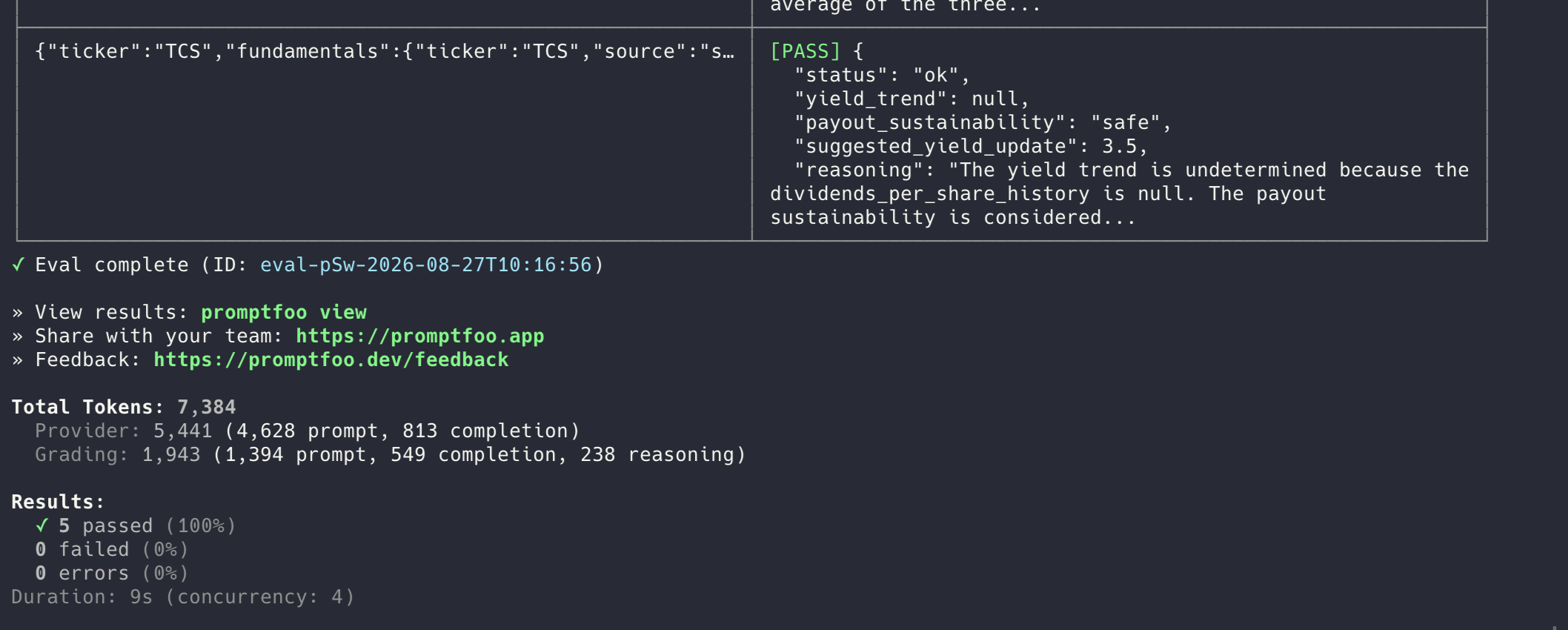
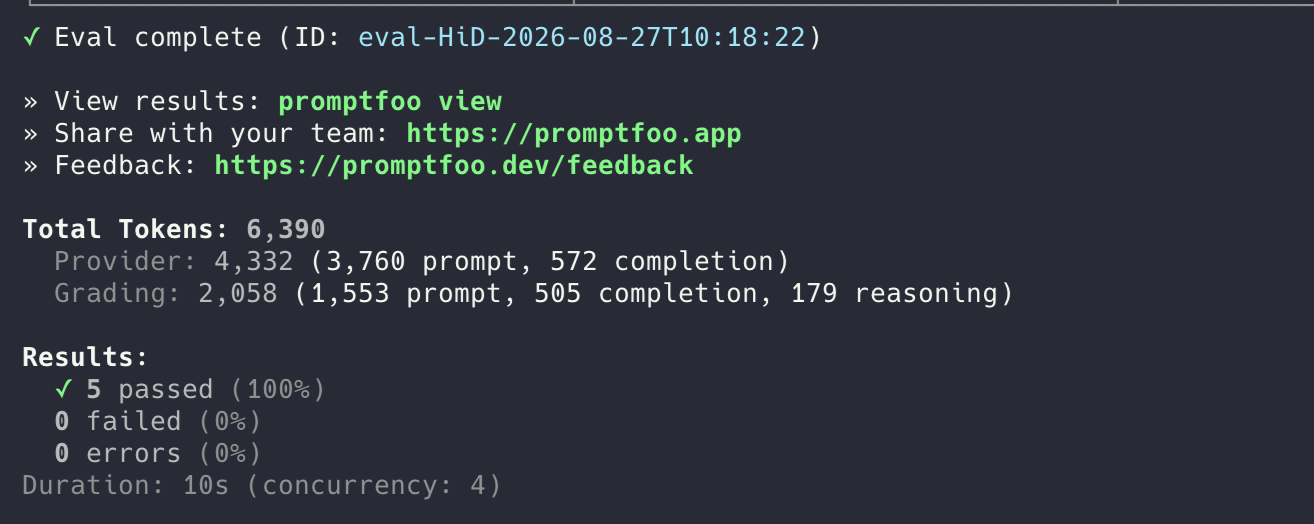
After all three fixes: 5/5 on both suites.
Provider Independence
The evals are written against the output contract — not against model-specific phrasing. The assertion JSON.parse(output).yield_trend === 'improving' doesn’t care what words the model used in its reasoning. The llm-rubric assertions check whether the reasoning is logically grounded in the input data, not whether it uses particular language.
To run the same evals against a different provider:
npx promptfoo eval -c evals/fundamentals_subagent/promptfoo.yaml \
  --providers anthropic:claude-sonnet-4-5-20251001
No YAML changes. If the assertions pass, the prompt works with that provider. If they fail, you know exactly which contract was violated and can fix the prompt rather than working around a specific model’s quirks.
Running the Evals
make eval               # both suites
make eval-fundamentals  # fundamentals only
make eval-risk          # risk only
make eval-view          # open results in browser
Requires OPENAI_API_KEY in .env and Node 22 (nvm use 22).
What’s Next
Part 4: github-pr-opener MCP tool — the missing piece that turns the coordinator’s diff into an actual GitHub PR on HiteshRepo/stock-screeners. Once that’s in, the full loop closes.