End-to-End Deployment and Live PR Generation (divvy-forge Part 4)
Note: This post was AI-generated from rough notes using the blog generation workflow.
This is part 4 of the divvy-forge series. Part 1 covered TrueForge + Daytona setup. Part 2 covered the MCP tool servers. Part 3 covered coordinator prompt design and evals.
The previous three posts built all the pieces: TrueForge and Daytona running locally, three MCP tool servers, a coordinator with tested subagent prompts. This post covers getting everything wired together and watching the agent open a real GitHub PR against my dividend portfolio.
It took more iteration than I expected. The TrueForge API has a few surprises.
Demo video: Watch on YouTube
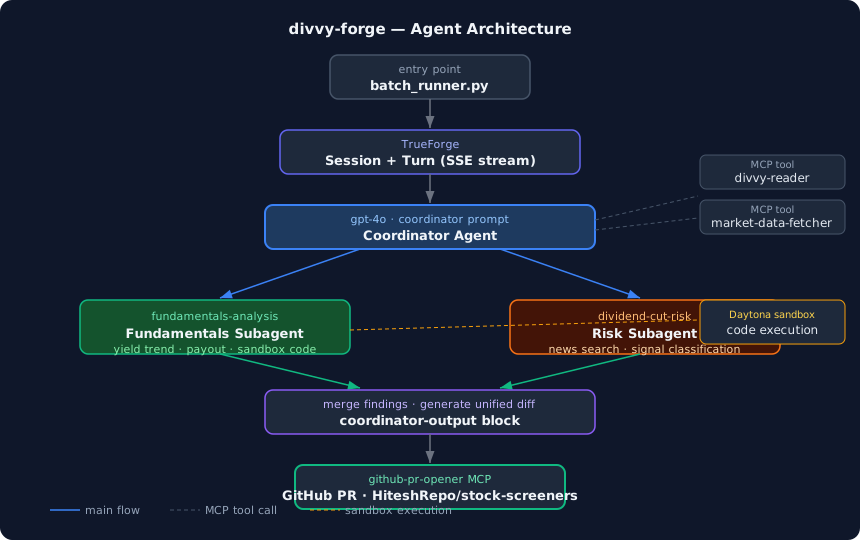
What Deployment Means Here
divvy-forge has no Kubernetes, no Docker Compose, no cloud deployment. “Deploy” means:
- Start three MCP servers as local HTTP processes
- Register them with TrueForge (Settings → Connectors)
- Register the coordinator agent with its manifest
- Run
batch_runner.py
I wrote a deploy.py script and a Makefile target to do steps 2 and 3 programmatically. The goal was make deploy as the single command before every run.
Discovering the Real API Shape
The TrueForge API is undocumented beyond the README. I probed it with curl to figure out what each endpoint actually accepts.
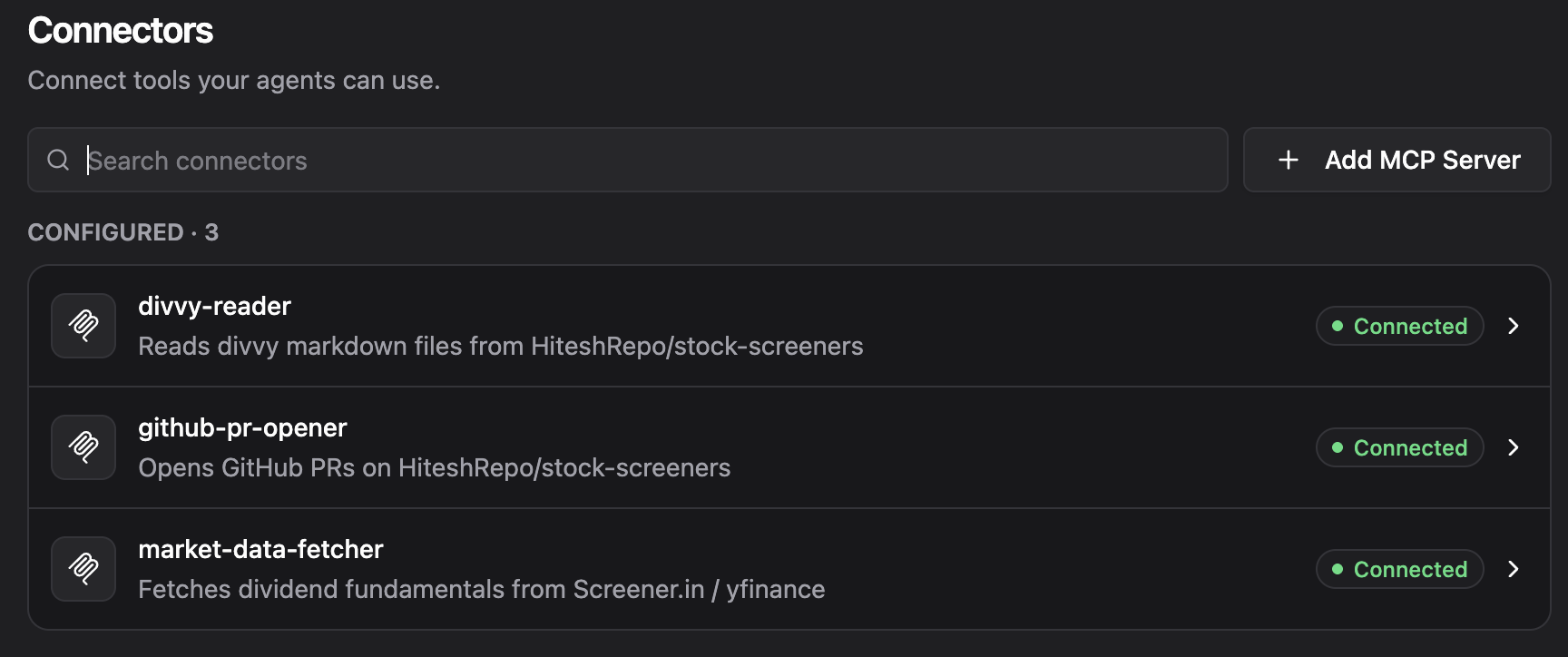
MCP server registration was the first surprise. I assumed POST /api/v1/settings/mcp-servers with {name, url}. The real schema:
{
  "manifest": {
    "type": "remote",
    "name": "divvy-reader",
    "url": "http://localhost:9001/sse",
    "description": "Reads divvy markdown files from HiteshRepo/stock-screeners"
  }
}
Two things wrong with my first attempt: the fields had to be nested under manifest, and type: "remote" was required. There is no stdio transport in TrueForge’s connector model — servers must be reachable over HTTP.
That meant updating each MCP server to support SSE transport alongside the existing stdio mode. FastMCP (the MCP Python SDK) supports this via mcp.run(transport="sse"). I added a --sse flag to each server’s entry point and Makefile targets to start them in HTTP mode:
make serve-divvy-reader-http    # port 9001
make serve-market-data-http     # port 9002
make serve-github-pr-http       # port 9003
The URL must include the /sse path — TrueForge uses the registered URL verbatim as the SSE endpoint, so http://localhost:9001 returns 404 while http://localhost:9001/sse returns the SSE stream.
Agent registration had the same pattern. I assumed the model was a string:
{"model": "openai/gpt-4o"}
It’s an object:
{"model": {"name": "openai/gpt-4o"}}
And MCP server references are objects too, not strings:
{"mcp_servers": [{"name": "divvy-reader"}]}
Once I had the right shapes, make deploy went green:
The Subagent Question
I spent time early on trying to figure out whether TrueForge supported dynamic subagents. The config accepts dynamic_sub_agents: {enabled: true} without complaint, but I couldn’t find the config key anywhere in TrueForge’s backend source. My first test ended with the coordinator outputting “I’ve launched the subagents for both fundamentals analysis and dividend cut risk assessment, I’ll wait for their findings” — zero tool calls, one sad turn, done.
The answer came from the database. TrueForge stores everything in SQLite. Looking at turn_thread rows, the agent run had only a main thread — no subagent threads were spawned.
Then I looked at an earlier run (before I knew the correct system prompt). That run showed something different: TrueForge’s UI rendered Sub-agent: fundamentals-analysis and Sub-agent: dividend-cut-risk as distinct steps in the agent flow. Subagents were supported — the coordinator prompt just wasn’t triggering them correctly.
Getting the Coordinator to Shut Up
The coordinator prompt had the agent announcing its intentions at every step. “I’ve read the ticker state. Now I’ll fetch fundamentals.” “Launching subagents now.” The problem: TrueForge ends a turn when the model produces text output. If the coordinator narrates while spawning subagents, the turn closes before it gets the results back.
The fix is simple but non-obvious: the coordinator must produce only tool calls during the subagent phase, no text. Any text in that model response becomes the turn’s final output.
I added an explicit instruction to the coordinator prompt:
**IMPORTANT: Output NO text in this step. Only tool calls.**
Do not write any message before, during, or after spawning the subagents.
Any text you output here will end your turn prematurely before you receive
the subagent results.
The same applies after subagents return. The coordinator must go directly from receiving results to merging and generating the diff — silently — and only produce text once it writes the coordinator-output JSON block.
Multi-Turn Continuation
Even with the silent subagent spawning, the coordinator’s work spans multiple turns. TrueForge’s ask_user_questions feature was also firing mid-run, pausing to ask which analysis path to take. I disabled it in the agent manifest config:
config:
  ask_user_questions:
    enabled: false
For the multi-turn problem, run_coordinator_turn needed a continuation loop. After each turn, it checks for the coordinator-output block. If not found, it submits a "continue" message on the same session and tries again, up to 10 times:
for _ in range(_MAX_CONTINUATION_TURNS - 1):
    continuation_output, _ = _stream_one_turn(
        client, session_id, "continue", threads_created, threads_done
    )
    if _COORDINATOR_OUTPUT_RE.search(final_output):
        data = _parse_coordinator_output(final_output)
        return _build_result(data, final_output, threads_created, threads_done)
Daytona Sandboxes Spinning Up
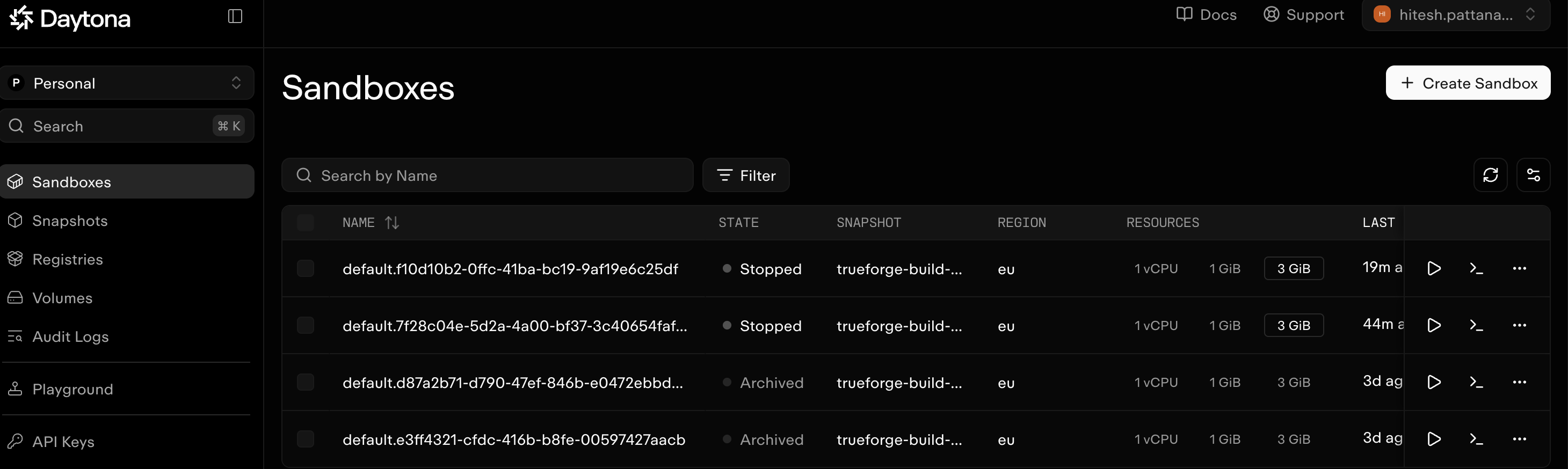
Each agent run creates a Daytona sandbox for code execution. The sandbox is where the fundamentals subagent runs its Python analysis — computing yield trend, payout sustainability, and the suggested yield update. TrueForge provisions the sandbox transparently; from the coordinator’s perspective it just calls a bash tool.
The Daytona dashboard shows the sandboxes spinning up per run, auto-stopping after 5 minutes of inactivity:
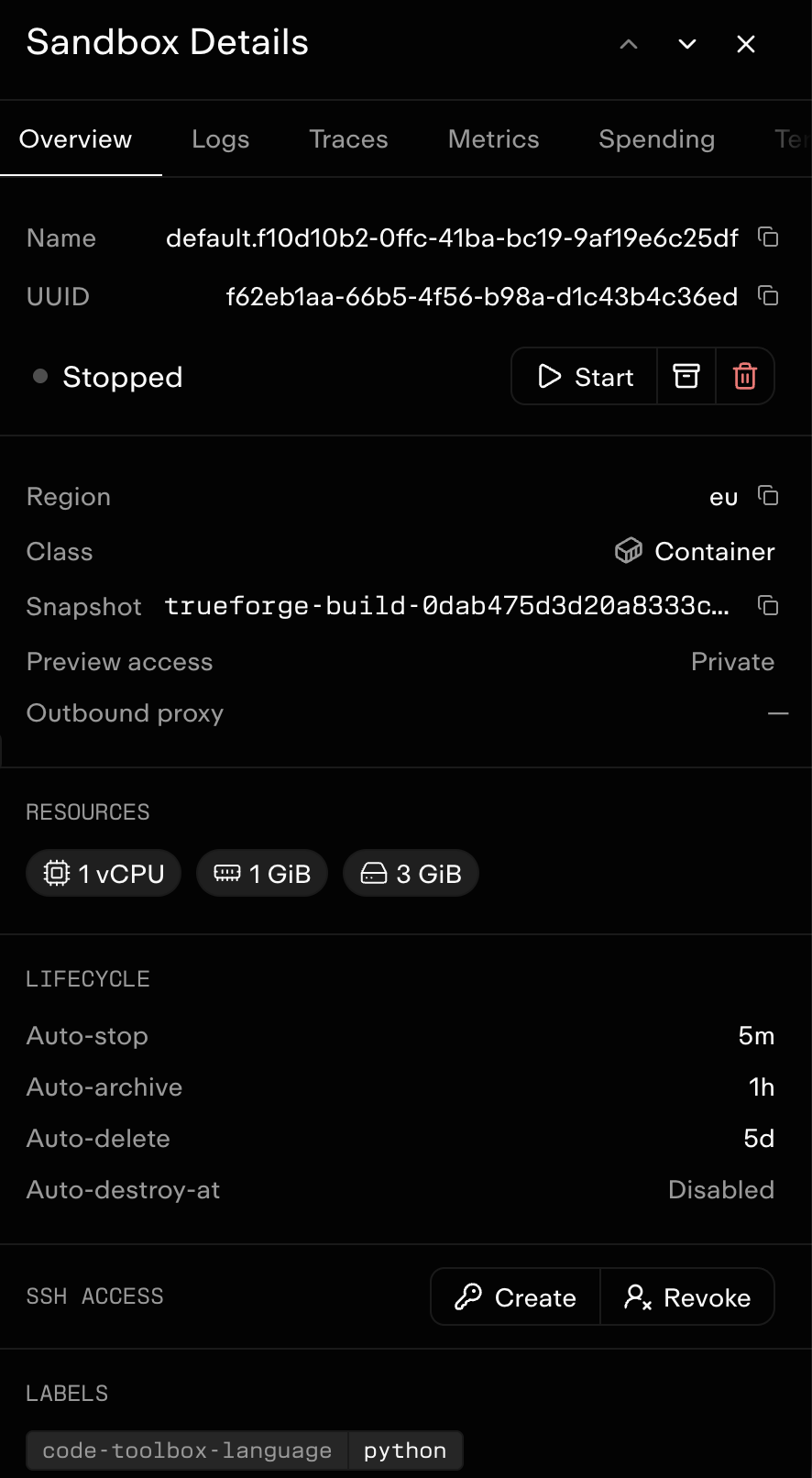
Each sandbox is a container with 1 vCPU, 1 GiB RAM, and 3 GiB storage — just enough to run a Python script:
The Agent Flow
With everything wired, a make single TICKER=INFY run produces this in TrueForge’s UI:
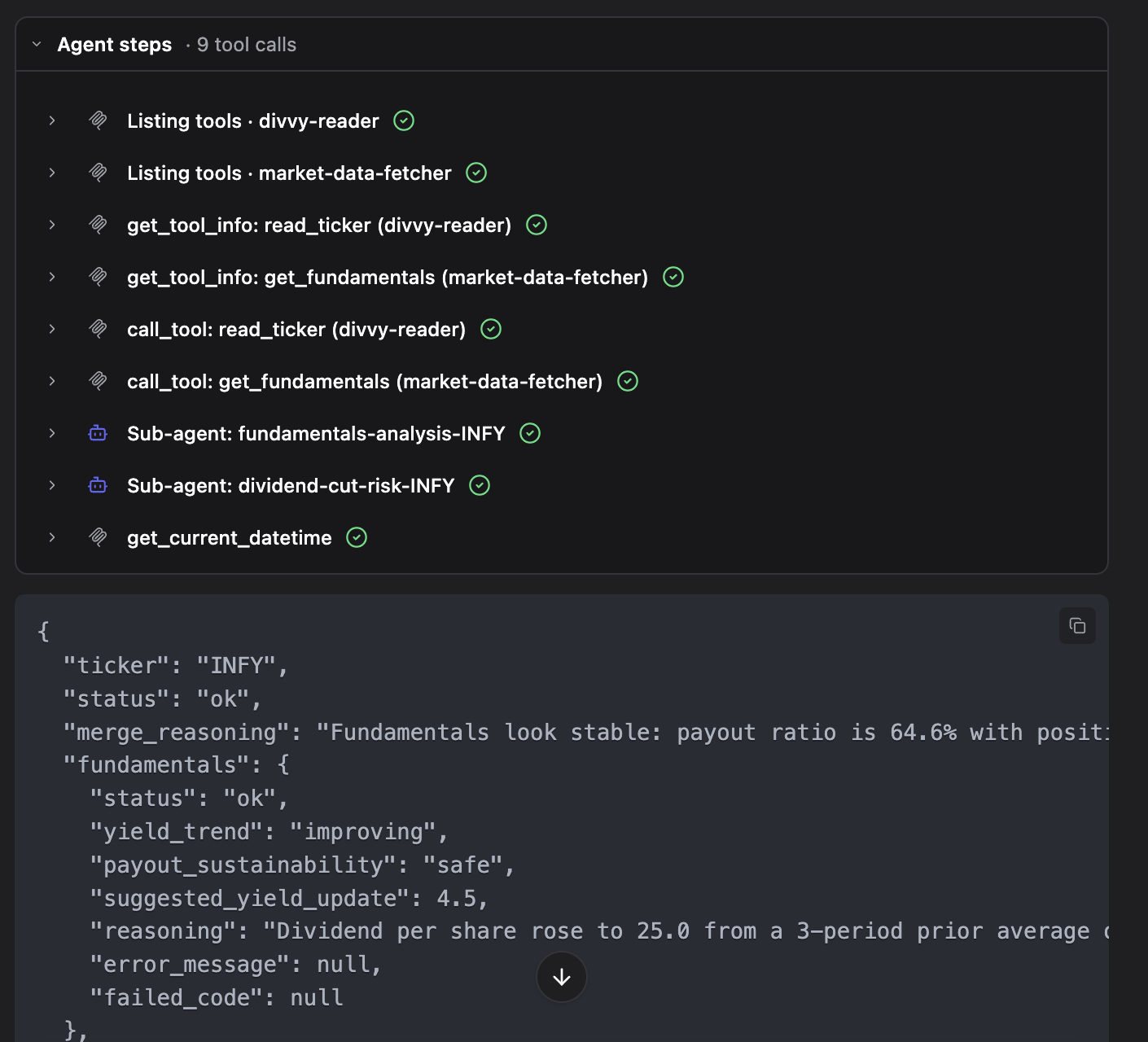
Nine tool calls in total:
read_ticker(divvy-reader) — loads current yield, payout ratio, notes, raw markdownget_fundamentals(market-data-fetcher) — fetches live data from yfinanceSub-agent: fundamentals-analysis— writes and executes Python in the Daytona sandbox, computes yield trend (improving: 25.0 vs 3-period avg 22.0) and payout sustainability (safe: 64.6% payout, positive FCF of 3.733B)Sub-agent: dividend-cut-risk— searches for recent dividend-cut signals (none found)get_current_datetime— stamps the review date- Coordinator merges findings, generates the unified diff, outputs
coordinator-outputJSON
The PR
The batch runner parses the coordinator-output block and hands it to github-pr-opener. The result:

The PR body has the coordinator’s reasoning, the diff, and collapsed sections for each subagent’s findings:
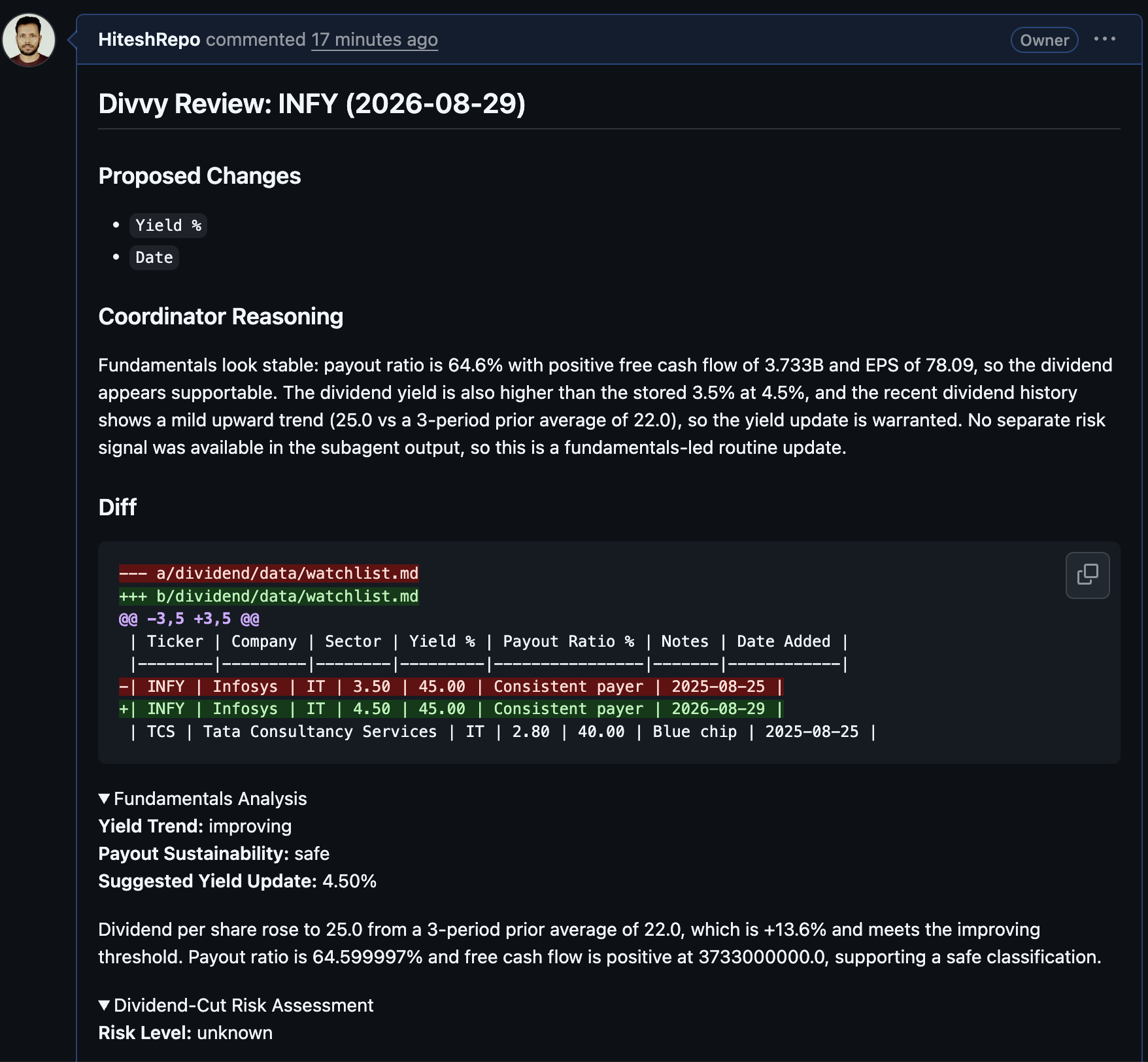
The diff itself is minimal — only the yield and date changed:
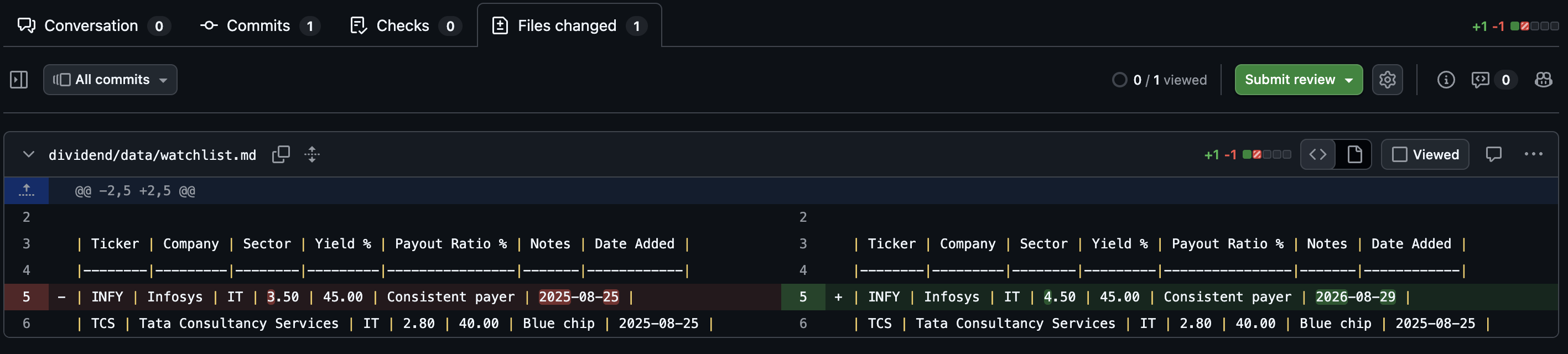
The coordinator’s reasoning is traceable: “Dividend per share rose to 25.0 from a 3-period prior average of 22.0, which is +13.6% and meets the improving threshold. Payout ratio is 64.6% and free cash flow is positive at 3733000000.0, supporting a safe classification.”
What I’d Do Differently
MCP server discovery at deploy time. Right now deploy.py hardcodes the server URLs (localhost:9001-9003). A cleaner approach would be to read URLs from a config file so the same script works against a remote TrueForge instance without edits.
Rate limit handling. The coordinator runs against a 30k TPM limit on the OpenAI free tier. The assembled prompt (coordinator system + subagent instructions + tool responses + subagent results) easily approaches that ceiling. I trimmed the subagent instruction files and switched to a higher-capacity model, but a proper fix would be retry-with-backoff in the streaming client.
Agent mode toggle. I added AGENT_MODE=single as a fallback for when TrueForge’s subagent mechanism isn’t available — the coordinator does the full analysis inline without spawning subagents. The subagent mode is the default; single is there for debugging or version compatibility.
Source
All the code is at https://github.com/HiteshRepo/divvy-forge.
The three earlier posts in the series cover the pieces that make this run: the TrueForge + Daytona setup, the MCP tool servers, and the coordinator prompt design with promptfoo evals.