Building MCP Tool Servers for a Dividend Review Agent (divvy-forge Part 2)
This is part 2 of the divvy-forge series. Part 1 covered getting TrueForge and Daytona running locally.
Demo video: Watch on YouTube
What We’re Building
divvy-forge is a TrueForge-hosted agent that automates dividend portfolio reviews. My portfolio lives as markdown files in a private GitHub repo (HiteshRepo/stock-screeners). The agent reads the current state, fetches fresh market data, and opens a GitHub PR with proposed changes. I merge the PR to approve — nothing is applied until then.
For the agent to do any of this, it needs tools. In TrueForge, tools are exposed as MCP servers — small processes that speak the Model Context Protocol over stdio. This post covers the two I built first:
- divvy-reader — reads the live portfolio state from GitHub
- market-data-fetcher — fetches fresh fundamentals from Screener.in (with yfinance fallback)
What MCP Actually Is
MCP is a JSON-RPC 2.0 protocol over stdio. The LLM runtime (TrueForge in our case) spawns your server as a subprocess and communicates through a three-phase handshake:
CLIENT                          SERVER
  |                               |
  |──── initialize ──────────────>|   version + capability negotiation
  |<─── result ───────────────────|
  |                               |
  |──── notifications/initialized>|   "ready" confirmation (no response)
  |                               |
  |──── tools/list ──────────────>|   schema discovery
  |<─── result ───────────────────|   JSON schemas for each tool
  |                               |
  |──── tools/call ──────────────>|   tool invocation
  |<─── result ───────────────────|   tool response
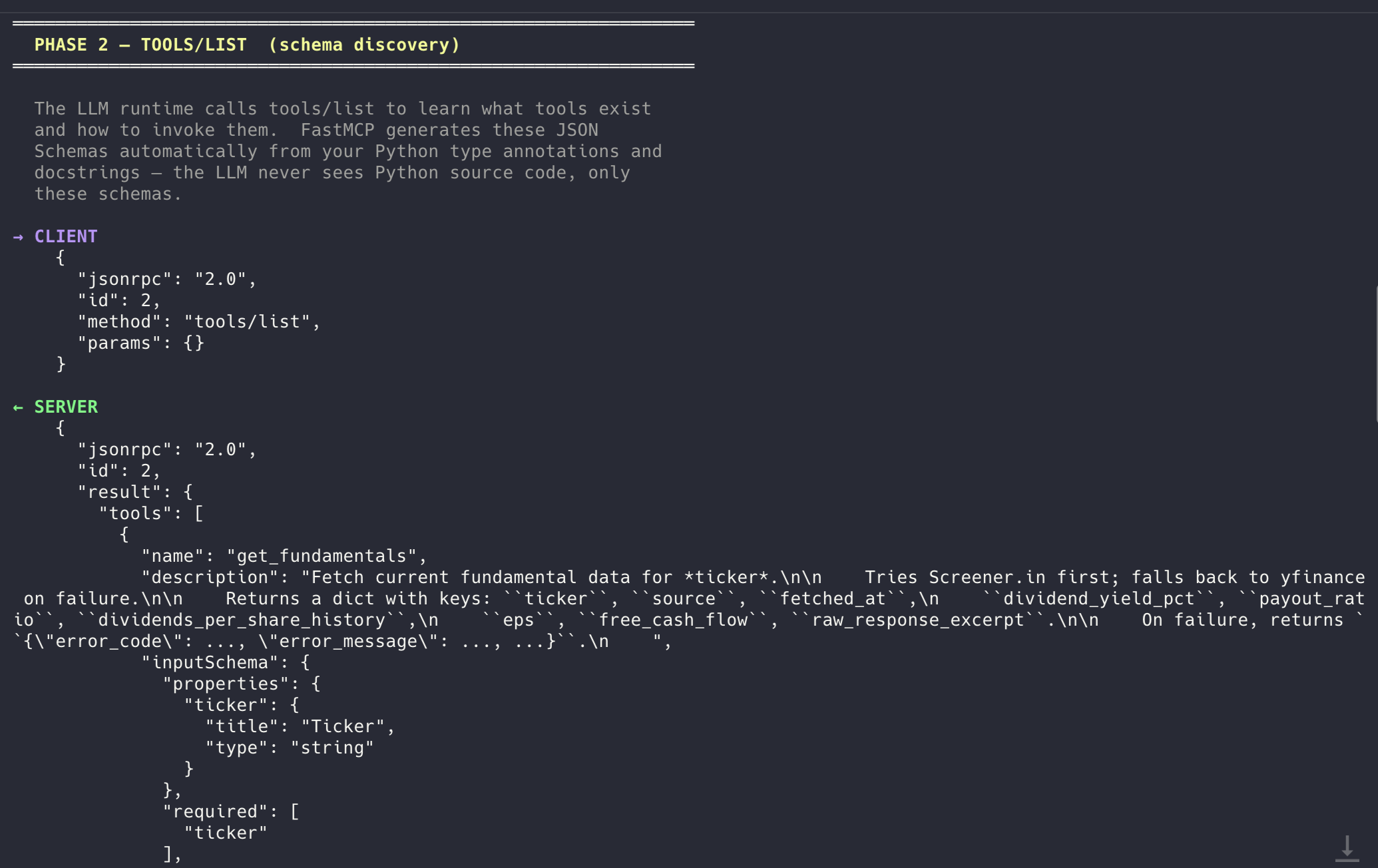
The key thing: the LLM never sees your Python source code. It only sees the JSON schemas returned by tools/list — the tool names, parameter types, and docstrings you write. FastMCP generates these schemas automatically from your type annotations.
divvy-reader
What it does: reads live dividend state from HiteshRepo/stock-screeners via the GitHub contents API. No local clone required.
Three tools
@mcp.tool()
def list_watchlist() -> list[str]:
    """Return an ordered list of ticker symbols from the divvy watchlist."""

@mcp.tool()
def read_ticker(ticker: str) -> dict:
    """Return parsed ticker state: yield_pct, payout_ratio,
    last_review_date, notes, raw_markdown."""

@mcp.tool()
def read_file(path: str) -> str:
    """Fetch raw file content from HiteshRepo/stock-screeners
    via the GitHub contents API."""
list_watchlist and read_ticker parse a markdown pipe table — dividend/data/watchlist.md — and return structured data. Any field that can’t be parsed comes back as null rather than raising an error.
raw_markdown in the read_ticker response is critical: the coordinator agent diffs against it when generating proposed changes, so format drift is contained — we’re always diffing against what’s actually in the file.
Running it
make inspect-divvy-reader   # opens MCP Inspector in browser
# or
make serve-divvy-reader     # raw stdio (for TrueForge wiring)
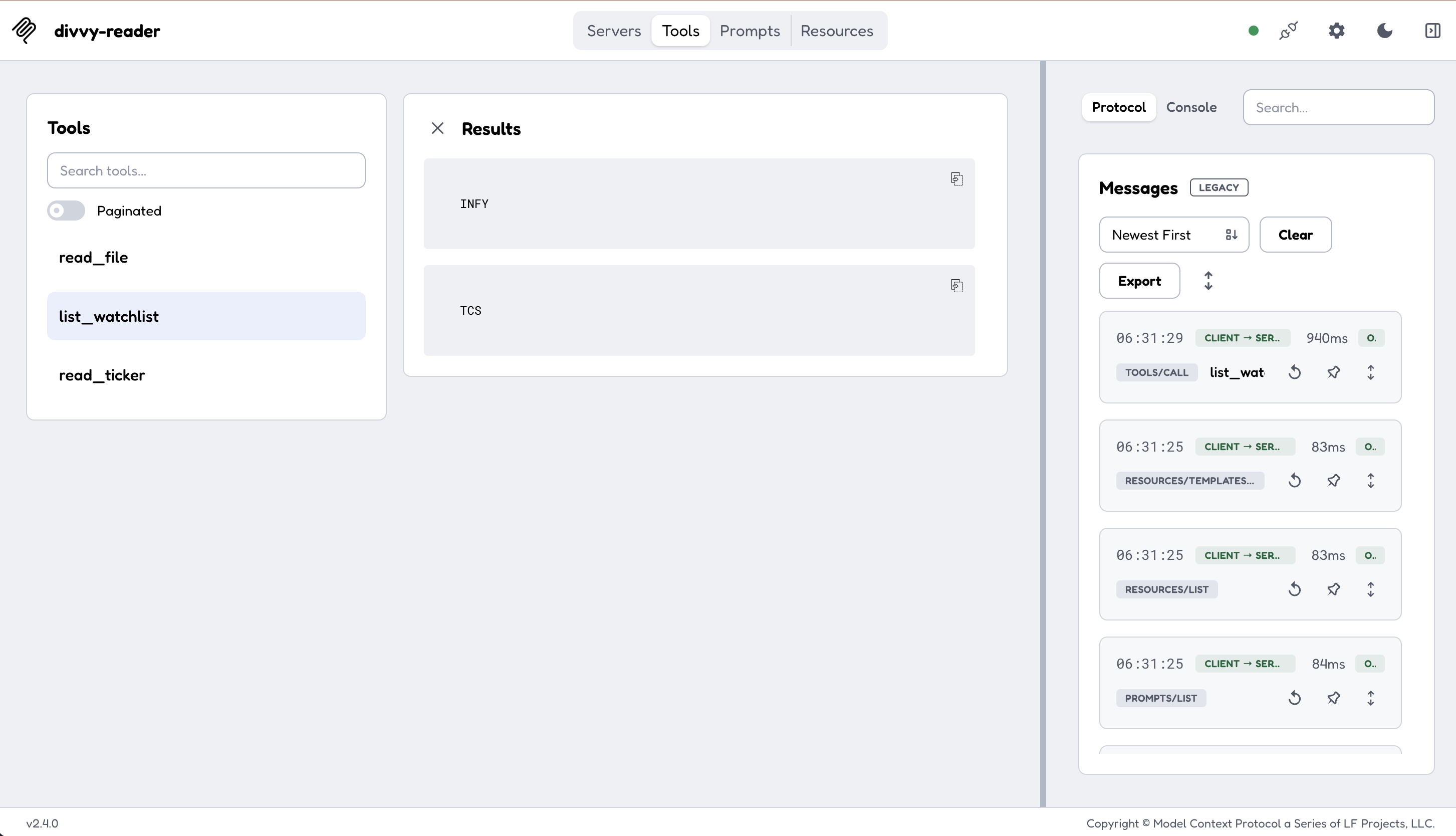
Here’s list_watchlist returning the live watchlist — INFY and TCS pulled directly from dividend/data/watchlist.md on GitHub:
What tools/list returns
This is exactly what the LLM sees — nothing more:
{
  "tools": [
    {
      "name": "list_watchlist",
      "description": "Return an ordered list of ticker symbols from the divvy watchlist.",
      "inputSchema": { "properties": {}, "required": [], "type": "object" }
    },
    {
      "name": "read_ticker",
      "description": "Return parsed ticker state for ticker from the divvy watchlist...",
      "inputSchema": {
        "properties": { "ticker": { "title": "Ticker", "type": "string" } },
        "required": ["ticker"],
        "type": "object"
      }
    }
  ]
}
market-data-fetcher
What it does: fetches current fundamental data for a ticker — dividend yield, payout ratio, EPS, FCF, and 5-year DPS history. Primary source is Screener.in; yfinance is the automatic fallback.
One tool
@mcp.tool()
def get_fundamentals(ticker: str) -> dict:
    """Fetch current fundamental data for ticker.
    Tries Screener.in first; falls back to yfinance on failure."""
The response always includes source, fetched_at, and raw_response_excerpt so the coordinator can trace every number back to where it came from.
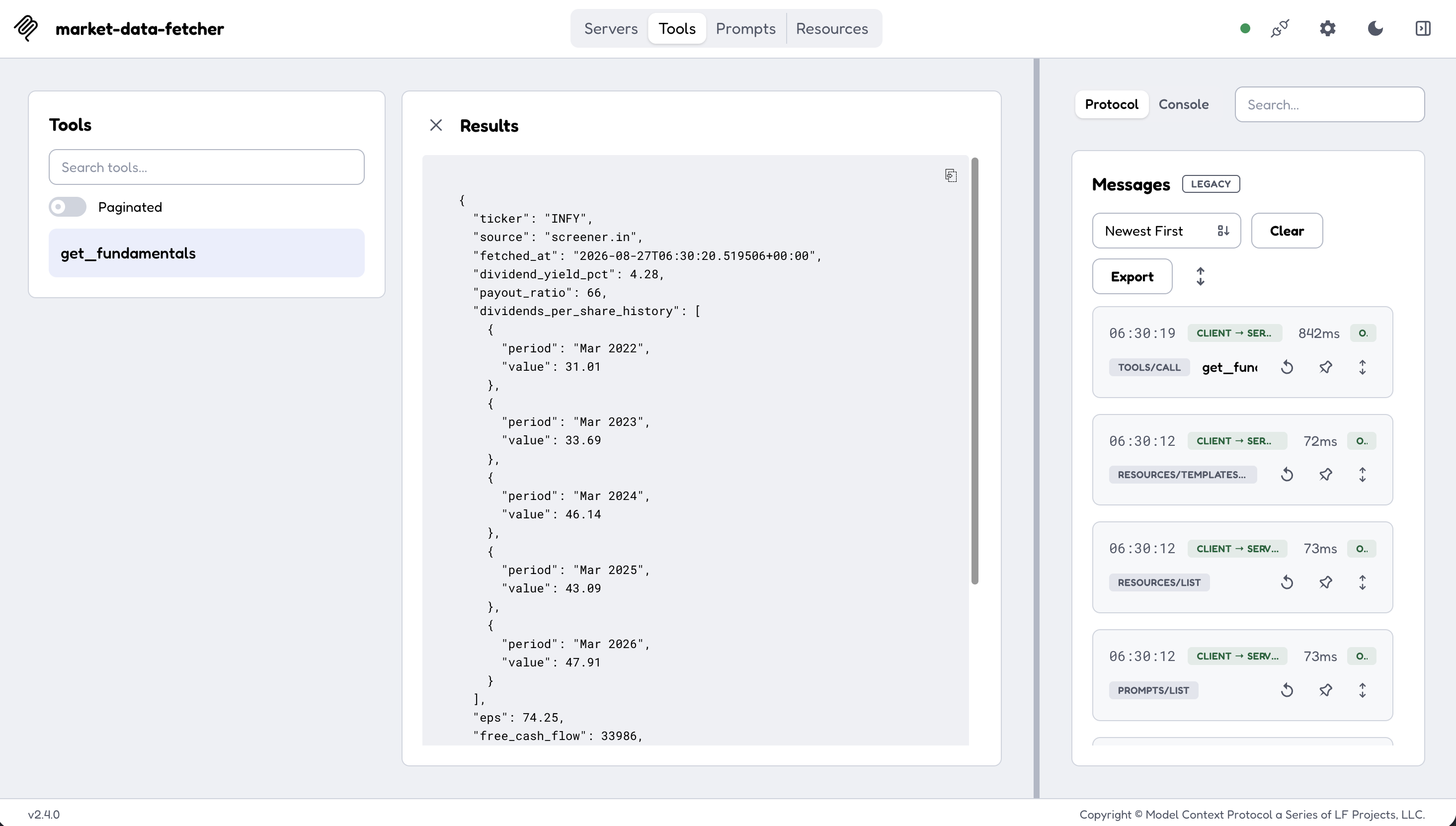
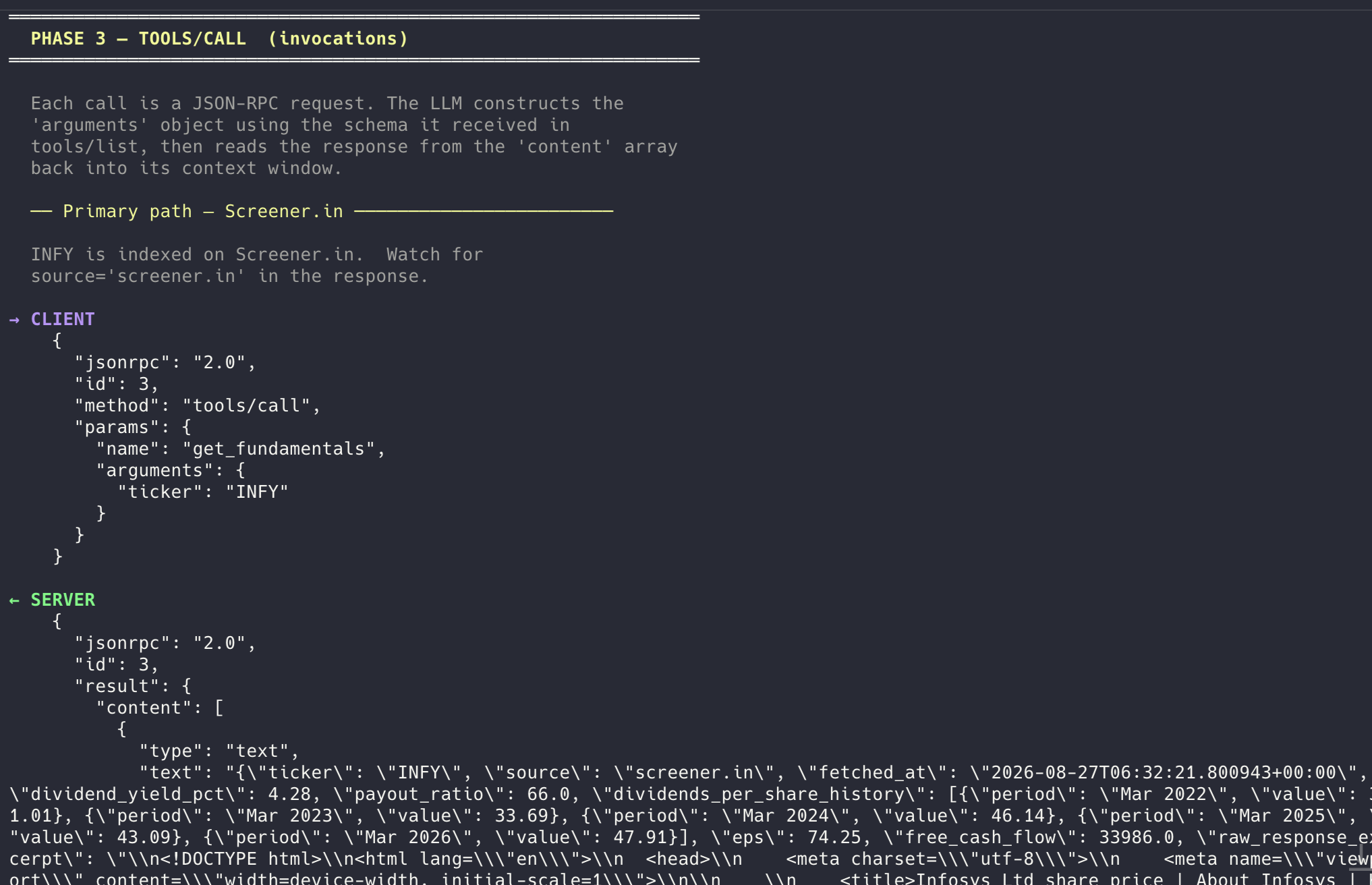
Here’s a live call for INFY — source: "screener.in", dividend yield, payout ratio, 5-year DPS history, EPS, and FCF all in one response:
Why not a JSON API?
I originally tried GET https://www.screener.in/api/company/INFY/ — got 404. Turns out Screener.in has no public JSON API for fundamentals. All the data is in the HTML page, and it’s public — no authentication needed.
The two-step scrape
# Step 1: confirm the ticker exists and resolve the canonical URL
GET /api/company/search/?q=INFY
# → [{"id": 1489, "url": "/company/INFY/consolidated/"}]

# Step 2: fetch and parse the HTML page
GET /company/INFY/consolidated/
BeautifulSoup parses three sections of the page:
| Section | Field extracted |
|---|---|
#top-ratios | dividend_yield_pct |
#profit-loss table | eps, payout_ratio, dividends_per_share_history |
#cash-flow table | free_cash_flow (operating CF − capex) |
dividends_per_share_history is computed as EPS × payout% / 100 for each annual period — Screener.in doesn’t give DPS directly.
# Parsing #top-ratios
section = soup.find(id="top-ratios")
for li in section.find_all("li"):
    name = li.find(class_="name").get_text(strip=True)
    value = li.find(class_="number").get_text(strip=True)
    # e.g. name="Dividend Yield", value="4.42 %"
Exponential backoff
The scraper retries on HTTP 429 and 5xx with a 1s initial delay, doubling each attempt, up to 3 retries before falling back to yfinance:
_INITIAL_BACKOFF_SECS: float = 1.0
_MAX_RETRIES: int = 3

for attempt in range(_MAX_RETRIES + 1):
    resp = client.get(url, headers=_HTML_HEADERS, follow_redirects=True)
    if resp.status_code == 200:
        return _parse_html(ticker, resp.text)
    if resp.status_code == 429 or resp.status_code >= 500:
        if attempt < _MAX_RETRIES:
            time.sleep(backoff)
            backoff *= 2
            continue
        break  # exhausted — fall back to yfinance
yfinance fallback
yfinance 1.6.0 (uses curl_cffi internally) handles Yahoo Finance’s rate limits much more reliably than older versions:
stock = yf.Ticker("INFY.NS")   # .NS suffix added automatically for bare NSE tickers
info = stock.info               # dividendYield, payoutRatio, trailingEps
dividends = stock.dividends     # historical dividend series
cashflow = stock.cashflow       # Free Cash Flow row
One breaking change in yfinance 1.x: dividendYield is now returned as a percentage (4.42) rather than a decimal (0.0442). payoutRatio is still decimal. Easy to miss.
Error contract
The tool never raises an exception to the LLM — on total failure it returns a structured dict:
{
  "error_code": "DATA_FETCH_FAILED",
  "error_message": "Both data sources failed for 'INFY'...",
  "ticker": "INFY",
  "screener_error": "...",
  "yfinance_error": "..."
}
The coordinator reads error_code and decides what to do — skip the ticker, retry later, or include a note in the PR.
Seeing the Raw Protocol
I wrote a small demo script (scripts/protocol_demo.py) that spawns a server subprocess and shows every JSON-RPC message in the terminal — useful for demos and understanding exactly what flows between the LLM runtime and your server:
python scripts/protocol_demo.py market-data
python scripts/protocol_demo.py divvy-reader
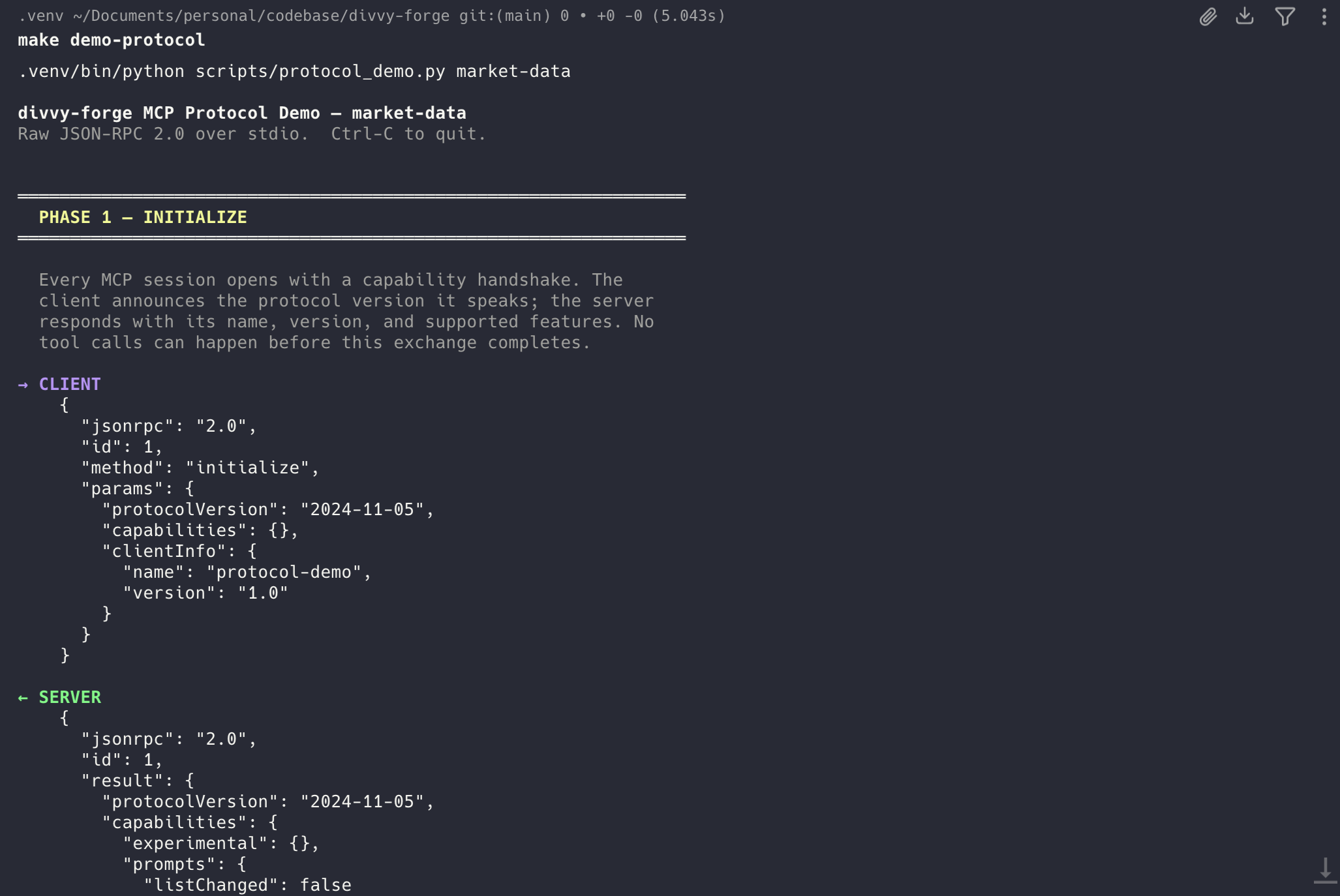
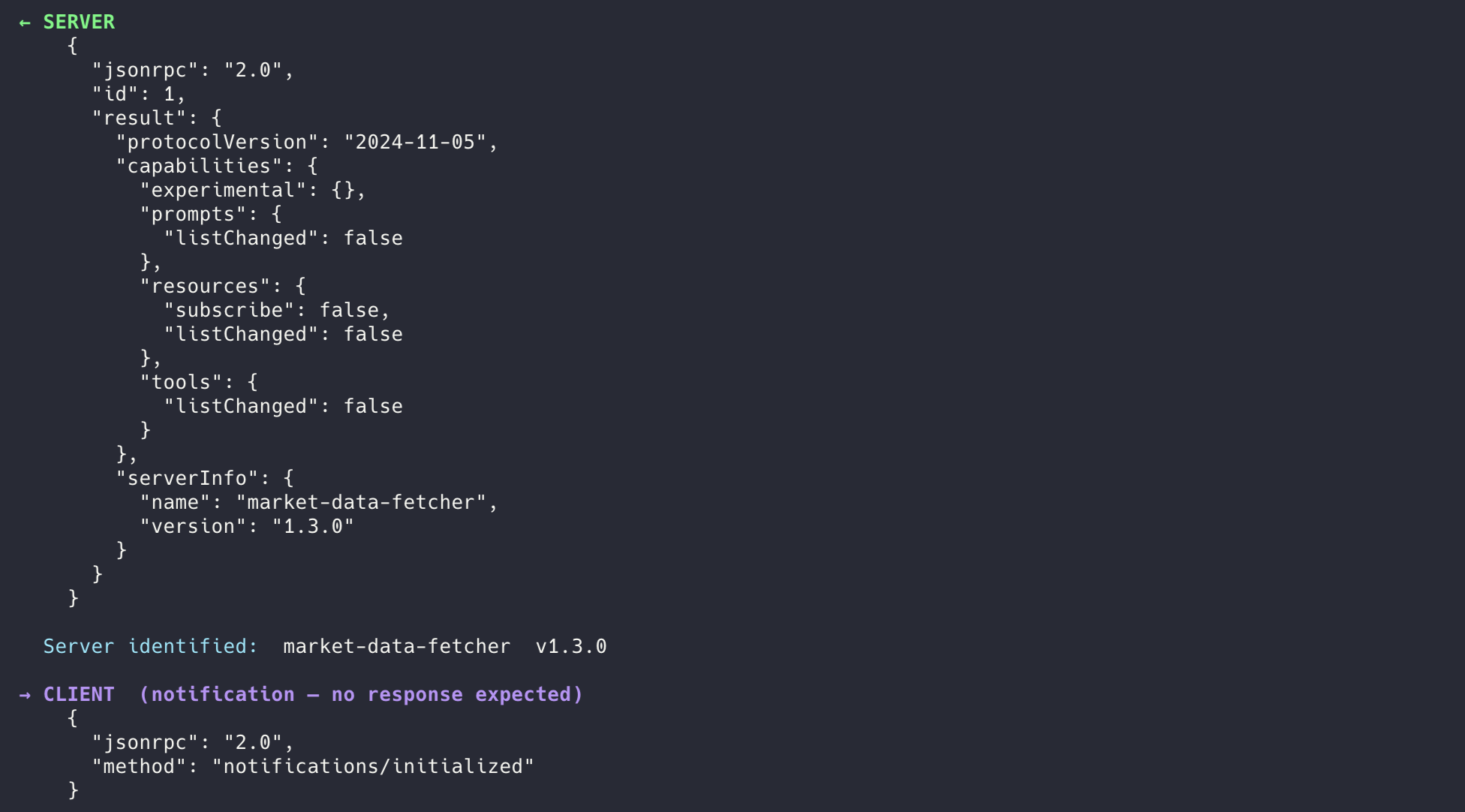
Phase 1 — INITIALIZE: the client announces the protocol version; the server responds with its name, version, and supported capabilities:
Phase 2 — TOOLS/LIST: the LLM runtime discovers what tools exist and their input schemas. This is the only thing the LLM ever sees — no Python source:
Phase 3 — TOOLS/CALL: the actual get_fundamentals invocation and the full response coming back through the protocol:
One gotcha I hit early: piping all three messages at once to the server causes:
RuntimeError: Received request before initialization was complete
tools/list arrived before the server finished processing initialize. The fix is to wait for each response before sending the next message — the protocol is strictly sequential during the handshake.
Running via MCP Inspector
The easiest way to test interactively:
make inspect-market-data   # opens browser UI
make inspect-divvy-reader
The Inspector handles the protocol handshake automatically. You can call tools, see the raw JSON request/response, and verify the schema — without writing any client code.
What’s Next
These two servers plug into the coordinator agent (in progress):
list_watchlist()→ get tickers to reviewread_ticker(ticker)→ current divvy stateget_fundamentals(ticker)→ fresh market data- Spawn two parallel subagents: fundamentals analysis + dividend-cut-risk
- Merge findings → generate unified diff → open PR on
HiteshRepo/stock-screeners
Part 3 will cover the coordinator prompt design and how TrueForge’s subagent delegation works in practice.